

ARTICLE | January 12, 2026
While G7 countries are rolling out sophisticated AI frameworks and international partnerships, Canadian businesses are taking a cautious approach that risks leaving them behind global competitors. For Northern Ontario businesses, this hesitation could have real consequences for competitiveness and growth.
Recent data from the Canadian Chamber of Commerce paints a concerning picture: AI adoption is growing, but it’s on a slower path than our international peers. The problem isn’t moving too fast. It’s not moving fast enough.
The Reality Check
Canada’s G7 partners recently concluded talks in Montreal with new commitments to help small and medium-sized businesses deploy artificial intelligence responsibly and at scale. They launched an SME AI Adoption Blueprint and companion toolkit specifically designed to help firms like yours get started. Meanwhile, most Canadian businesses, especially smaller ones, have taken no action at all.
This wait-and-see approach might feel prudent, but it’s risky. AI adoption is becoming a skills story. The gap is widening between companies that are building AI capabilities and those that aren’t. Advanced AI use is concentrating in knowledge-intensive sectors like professional services and finance, but practical applications exist for every industry, from manufacturing to construction to retail.
What This Means for Northern Ontario
Northern Ontario businesses face unique challenges: distance from major markets, smaller talent pools, and industries built on physical operations rather than digital services. These realities make AI adoption feel distant or irrelevant. But the opposite is true.
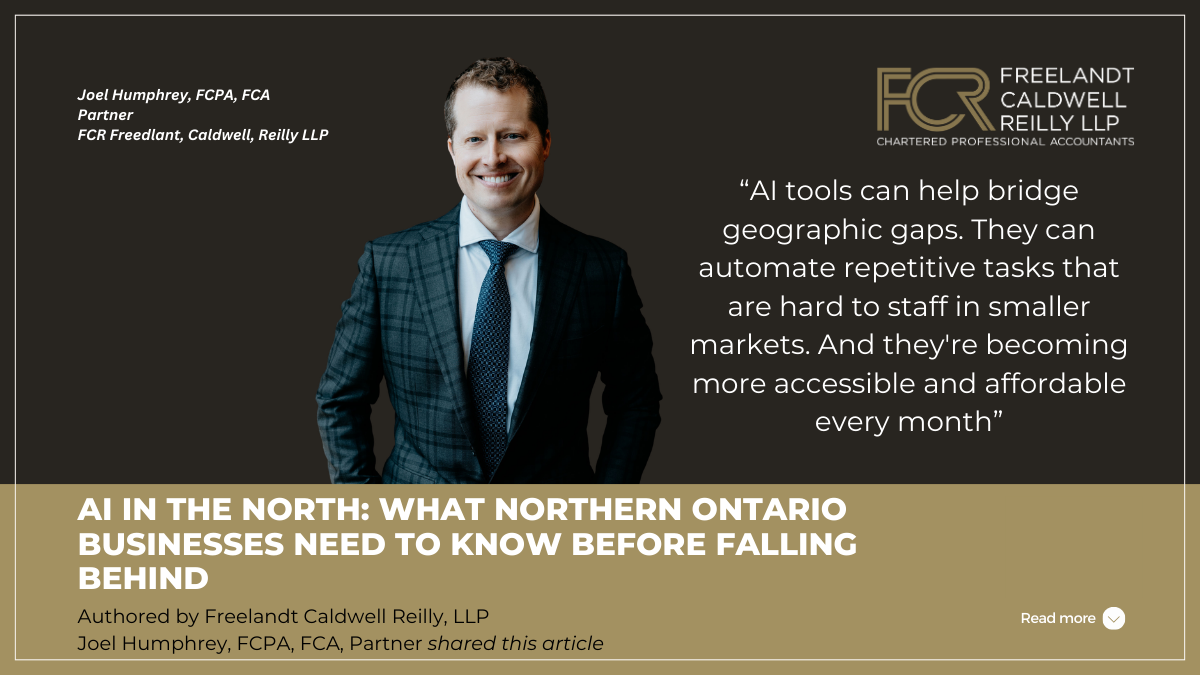
According to Joel Humphrey, “AI tools can help bridge geographic gaps. They can automate repetitive tasks that are hard to staff in smaller markets. They can provide data insights that help you compete with larger companies. And they’re becoming more accessible and affordable every month”.
The businesses using AI aren’t cutting jobs; they’re retooling workflows and training staff. High-AI sectors are still hiring, including entry-level positions. The transition looks manageable for companies that start now, but the longer you wait, the steeper the learning curve becomes.
Starting Points for Northern Ontario Businesses
You don’t need to overhaul your entire operation. Start with areas where AI can deliver immediate value:
Financial Operations: AI-powered bookkeeping tools can categorize transactions, flag anomalies, and generate reports automatically. This frees your team to focus on analysis and planning rather than data entry.
Customer Service: Chatbots and automated response systems can handle routine inquiries, especially valuable if you serve customers across time zones or have limited front-line staff.
Inventory and Supply Chain: AI can optimize ordering patterns, predict demand fluctuations, and identify cost savings in your supply chain, critical advantages in industries with tight margins.
Workforce Planning: AI tools can help with scheduling, identify training needs, and support recruitment by screening applications faster and more consistently.
The Competitiveness Question
Trade uncertainty and economic headwinds are making business planning harder. Many Northern Ontario companies are in defensive mode, postponing investments and waiting for clarity. But competitiveness depends on skills, investment, and the ability to adapt before external pressures force your hand.
Your competitors, in Southern Ontario and beyond, are moving forward. International competitors backed by government AI initiatives are moving even faster. The question isn’t whether AI will reshape your industry. It’s whether you’ll be ready when it does.
Where to Begin
Canada’s new SME AI Toolkit provides practical resources to help firms adopt AI responsibly. Start there. Talk to your accountant or business advisor about where AI could improve efficiency in your operations. Look at what software providers in your industry are offering. Most importantly, start building knowledge within your team now.
The businesses that thrive in 2026 and beyond will be those that treat AI adoption as an ongoing process, not a one-time decision. They’ll invest in training, experiment with tools, and build capabilities gradually. They won’t wait for perfect conditions or complete certainty.
Northern Ontario has always been home to resilient, innovative businesses. The AI transition is your opportunity to prove it again.

Let’s Talk!
Call us at 1 855 363 3526 or fill out the form below and we’ll contact you to discuss your specific situation.