

ARTICLE | December 10, 2025
After years of aspiring CPAs writing the intensive three-day Common Final Examination, that familiar rite of passage is coming to an end. The CFE will hold its last sittings in September 2028, making way for an entirely reimagined approach to CPA certification.
The phase-out represents a fundamental shift in how Canada’s accounting bodies think about professional education. The new CPA Professional Program, launching with its first modules in May 2027, introduces a modular structure with progressive assessments, eliminates traditional university program accreditation, and refocuses educational priorities around skills development rather than pure technical knowledge.
The New CPA Professional Program: Key Changes
The current system of accrediting specific undergraduate programs is being discontinued. Instead, institutions offering accounting majors will be encouraged to align their curricula with seven recommended core accounting courses plus eight additional business-related courses. Students without an accounting major can enter the professional program by completing a knowledge assessment.
The new program breaks the professional education journey into four distinct phases:
Foundational Development: Establishes core competencies and a common baseline across all candidates.
CPA Core (Common or Licensure): The Common pathway provides technical knowledge for most accounting roles, while the Licensure pathway is designed for those practicing in areas requiring public protection, such as auditing public corporations. The Licensure stream includes more complex corporate tax planning topics.
CPA Leadership: Emphasizes leadership, communication, and strategic thinking.
CPA Professional Readiness: A one-week in-residence program occurring after candidates complete their practical experience requirements.
Rather than a single three-day exam, candidates face assessments tied to completion of each module. These assessments will be offered three times per year, providing additional flexibility and creating progressive evaluation where candidates continuously demonstrate competency.
Tax Education Under the New Framework
Post-secondary institutions will be guided toward offering just one tax course as part of the seven core accounting courses – a potential reduction from many institutions where two tax courses are currently common. The content will cover fundamental concepts of Canadian taxation, but the pedagogical emphasis is shifting significantly toward skills development: research capabilities, decision-making competencies, and communication skills rather than memorization of specific technical tax rules.
The shift to a one-course recommendation creates both risks and opportunities. Some institutions may reduce their offerings to align with the minimum recommended curriculum, raising concerns about the depth of tax knowledge students bring into the professional program. However, the framework explicitly encourages institutions to offer additional tax electives, allowing progressive schools to differentiate their programs.
The CPA Core Common module includes enhanced tax elements compared to the current program, meaning non-licensure candidates will encounter somewhat more tax content than under the existing system. For candidates pursuing the Licensure pathway, tax content becomes more substantial, covering corporate reorganizations, tax-effective business structures, cross-border considerations, and sophisticated tax minimization strategies.
What This Means for Stakeholders
Current CPA Candidates: If your timeline puts you at risk of writing after September 2028, carefully evaluate your options. Consult with your provincial body, mentors, and employers to make informed decisions.
Prospective Students: When evaluating universities, look beyond marketing materials. For those interested in tax, the availability of tax electives beyond the single required course becomes crucial. The new framework’s flexibility means institutional offerings may diverge significantly.
Employers: Your workforce will include CPAs educated under different systems. You’ll need to distinguish between those who completed the licensure pathway with enhanced technical content and those who pursued the common pathway. Recruitment strategies may need adjustment – probe more deeply into what courses candidates took and what assessment pathway they followed.
The Path Forward
The new CPA Professional Program flows directly from Competency Map 2.0, reflecting the profession’s shift toward skills-based education. While technical knowledge remains essential, the emphasis is on capabilities like analytical thinking, professional judgment, and adaptability – skills that matter most as automation handles routine tasks and business complexity increases.
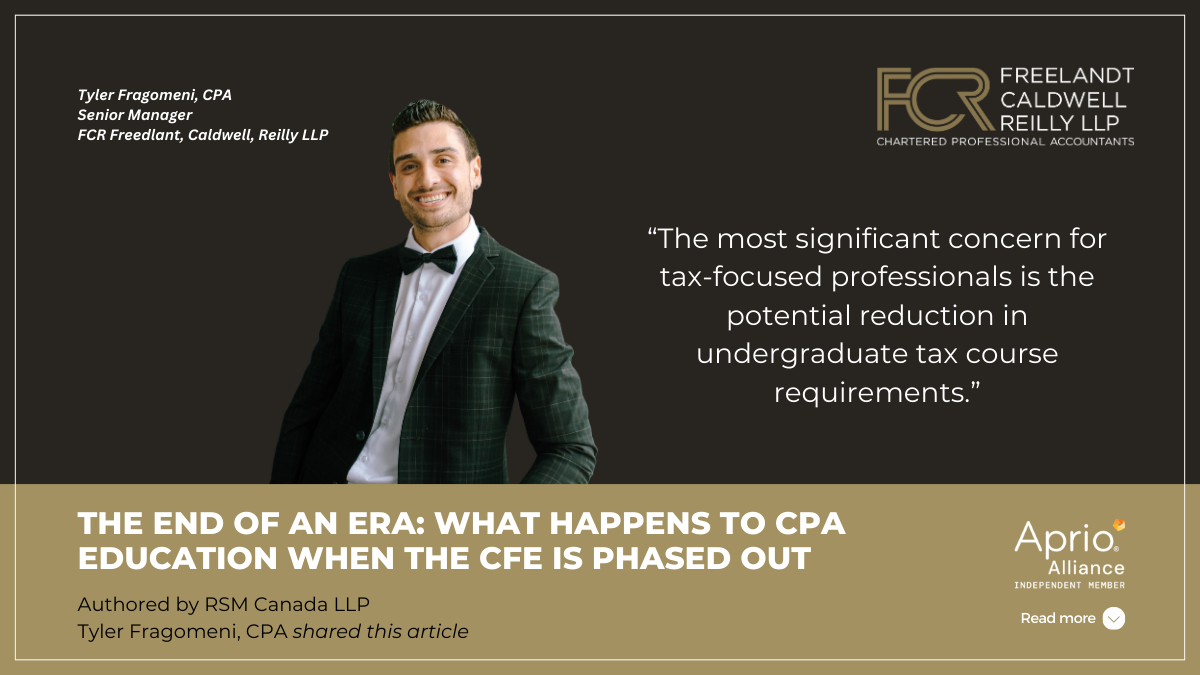
“The most significant concern for tax-focused professionals is the potential reduction in undergraduate tax course requirements” Tyler Fragomeni states. This places greater responsibility on individual candidates to proactively seek tax education opportunities beyond minimum requirements through electives, mentorship, and continuing professional development.
However, the modular structure provides flexibility that many candidates will find advantageous, and the skills-based emphasis creates better alignment between what candidates learn and what they’ll need in practice.
The end of the CFE signals the profession’s embrace of a more flexible, skills-focused, and practice-aligned approach to developing competent accounting professionals. Those who understand and adapt to these changes will be best positioned to thrive in the future of Canadian accounting.

Let’s Talk!
Call us at 1 855 363 3526 or fill out the form below and we’ll contact you to discuss your specific situation.